
Last updated September 22, 2026
Free on-site gate assessment - hinges, posts, and your LiftMaster or Nice gate operator checked before anything is quoted
The assessment is free and the quote is the invoice.
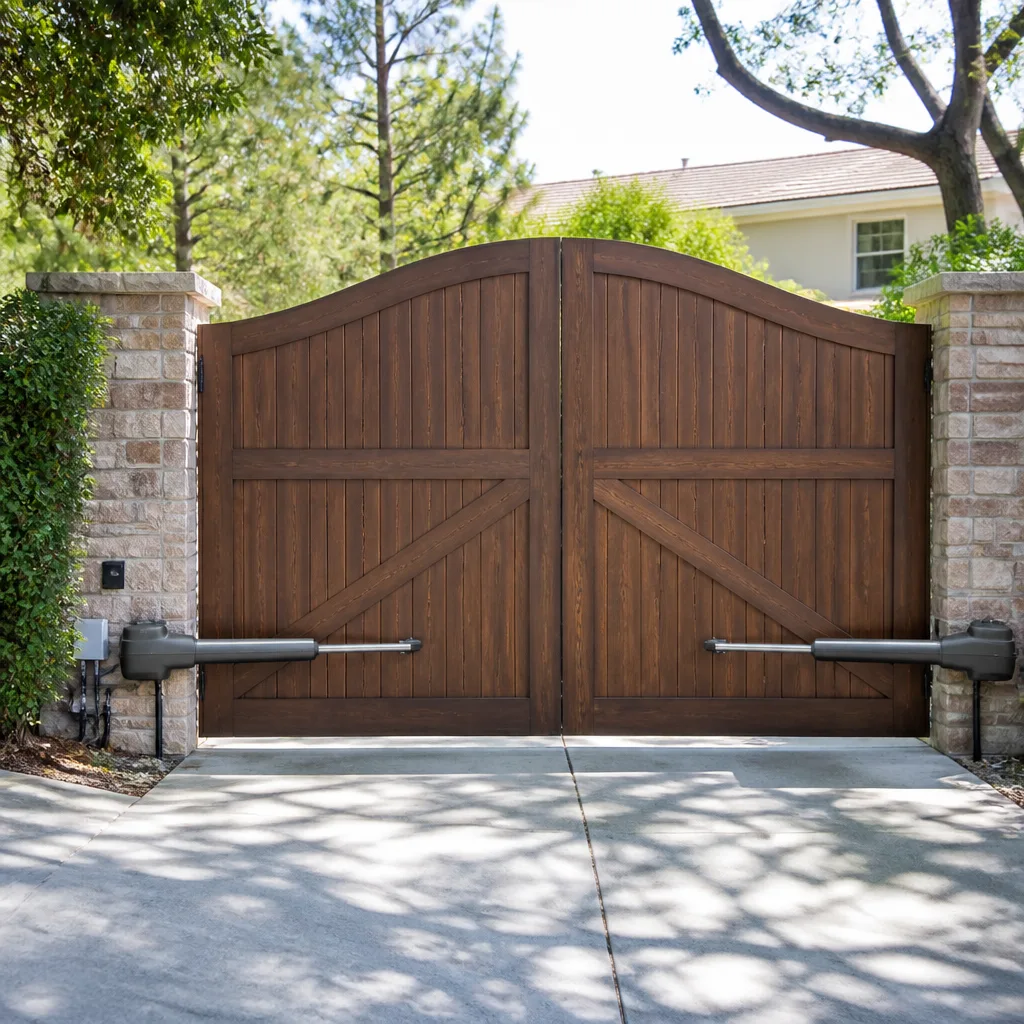
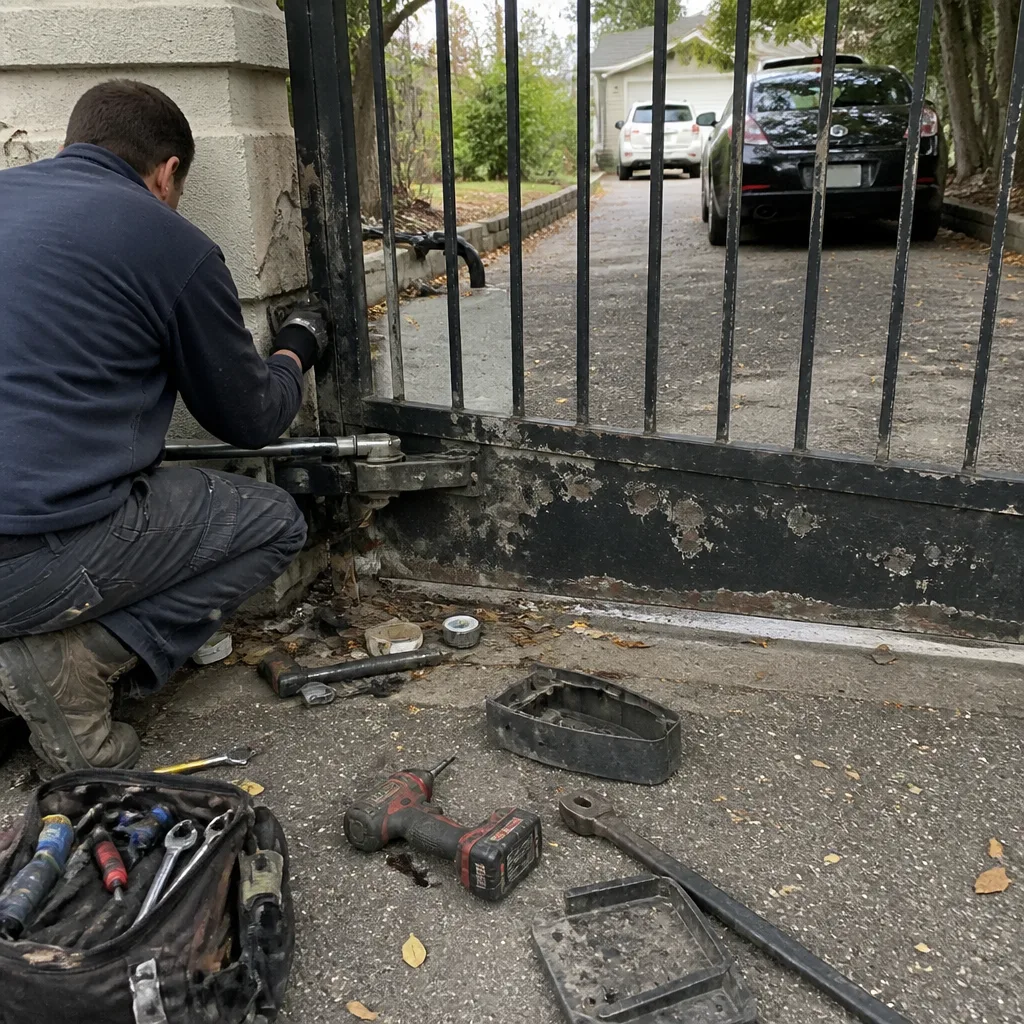 Before
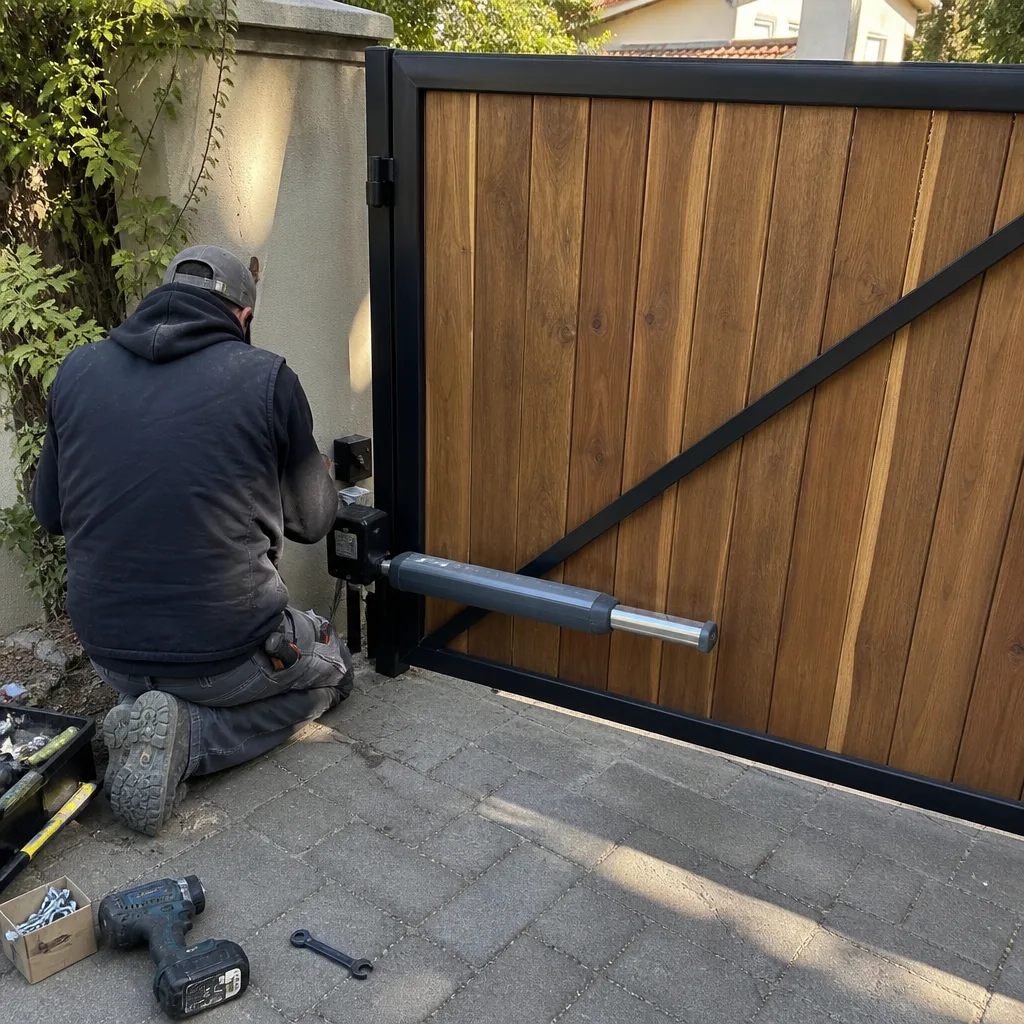 After
After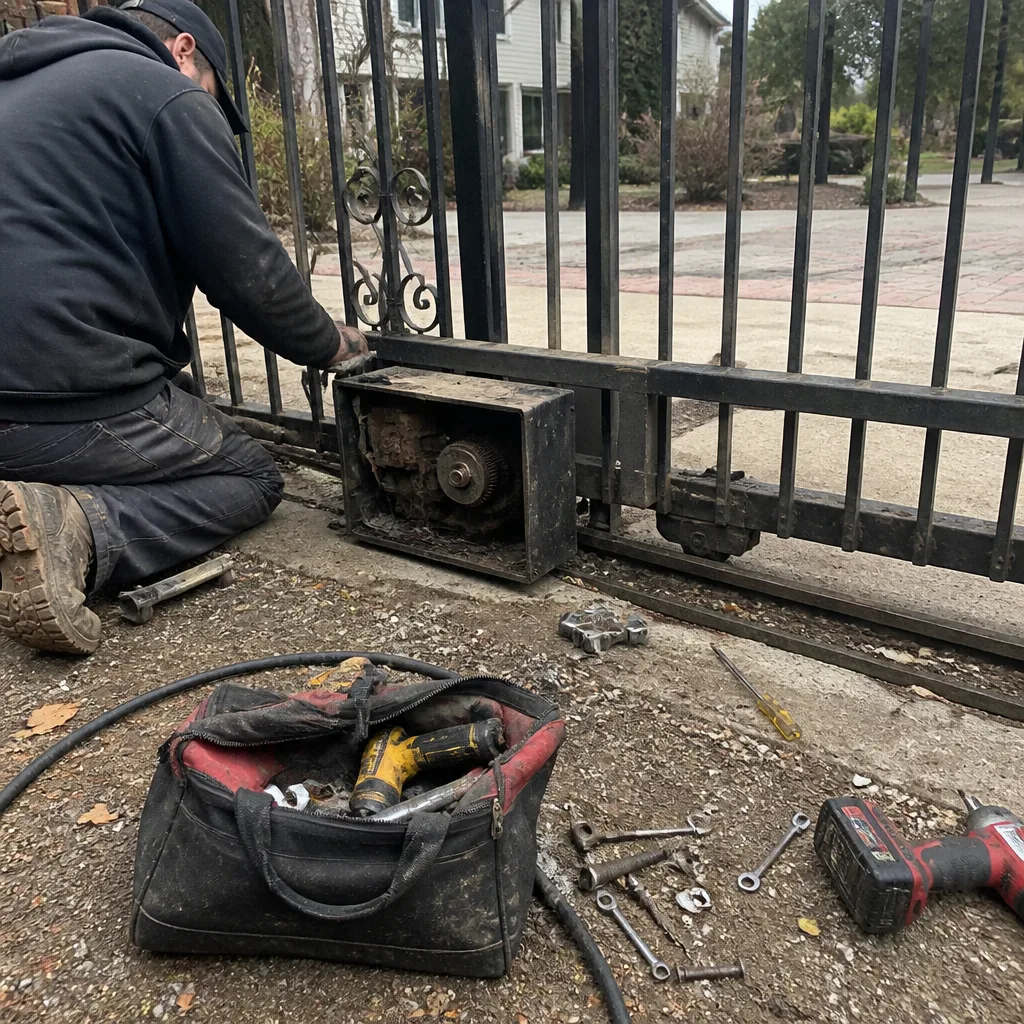 Before
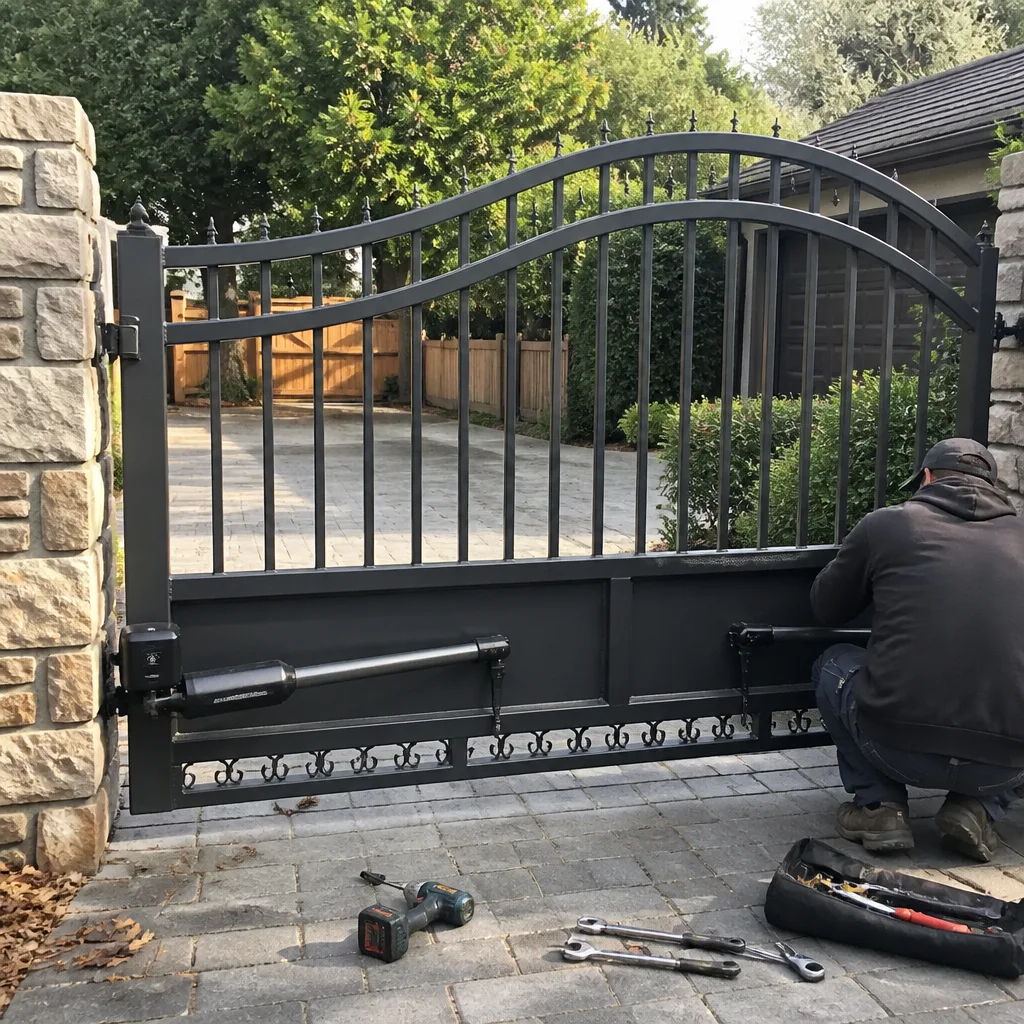 After
After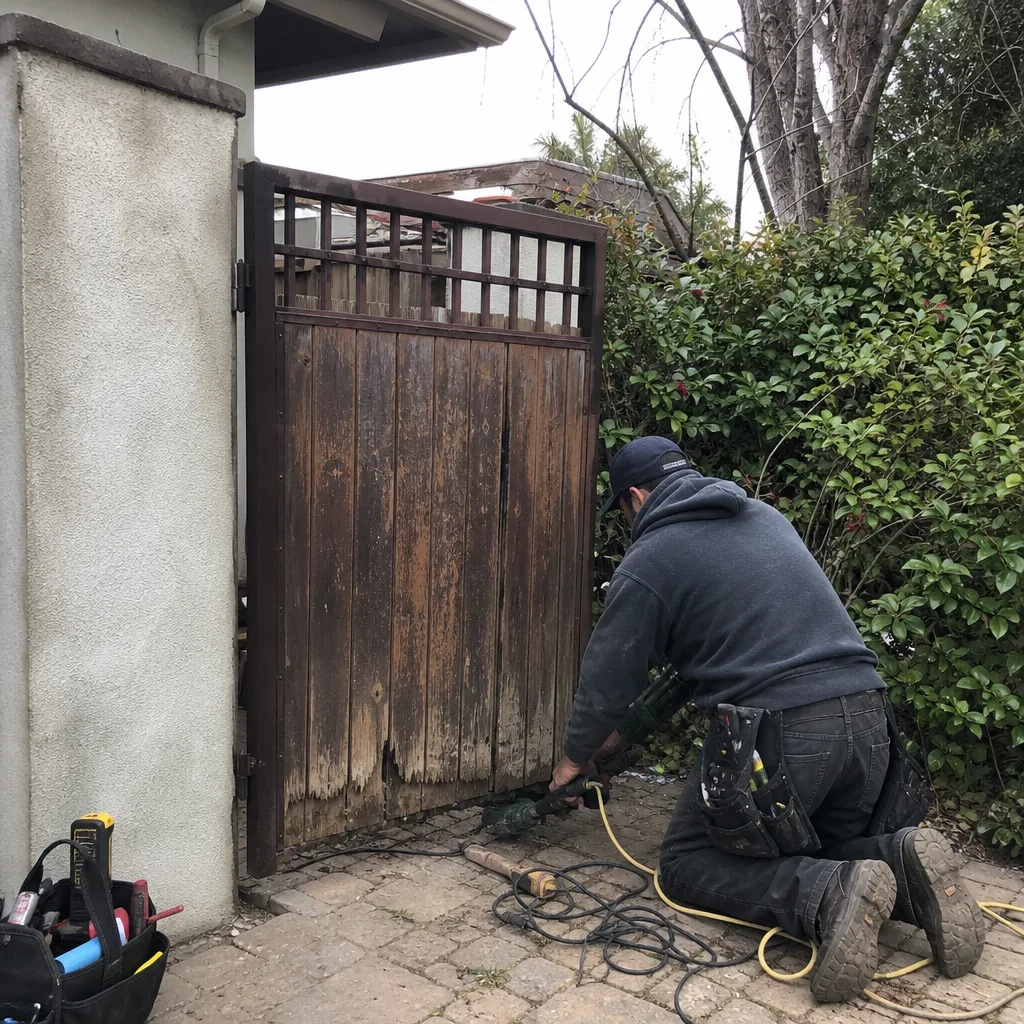 Before
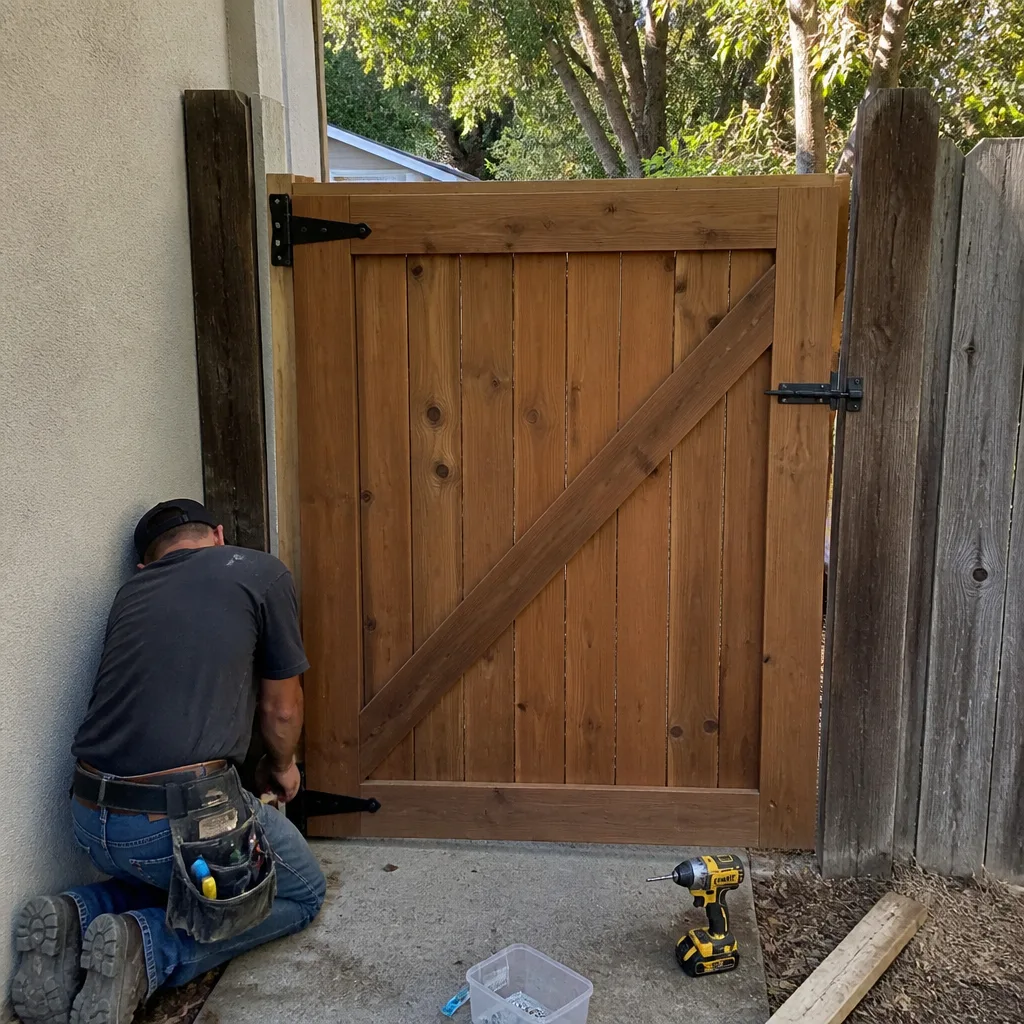 After
AfterDIY vs Professional Gate Repair: The Los Gatos Homeowner’s Decision Guide
Replacing a gate remote battery is DIY. Adjusting a limit switch looks just as simple and has sent gates into posts, vehicles, and people. The adjustment range is measured in millimeters, and the consequence of overshoot is immediate and physical. In Los Gatos, where hillside driveways often slope toward the street and gates carry 400 to 800 pounds of steel or redwood, the wrong repair decision doesn’t just cost money. It can damage property or injure someone. This guide draws a precise line between what you can safely handle yourself, what requires a documented baseline before you touch it, and what should never be attempted without training and test equipment. You’ll learn the specific UL 325 safety tests California homeowners are legally responsible for, how to document settings before adjustment, and what common DIY attempts actually cost when they fail.
Quick Answer
Most Los Gatos homeowners can handle battery replacement, photo-eye cleaning, and debris removal themselves. Tasks involving limit switches, control boards, safety-device testing, or any welding should be left to a professional with a meter and documented procedures. The dividing line is reversibility: if a mistake can be undone with a screwdriver and five minutes, it’s reasonable DIY; if a mistake bends steel or bypasses a safety circuit, it isn’t.
Table of Contents
- The Reversibility Rule: The Real Decision Framework
- DIY Tasks You Can Handle Safely
- DIY With Documented Baseline First
- Professional-Only: Tasks That Require Training and Equipment
- UL 325 Safety Tests: What California Homeowners Must Know
- Real Cost Comparison: DIY vs Professional in Los Gatos (2026)
- Common Mistakes to Avoid
- When to Call a Professional
- Frequently Asked Questions
- The Bottom Line
BeforeAfterThe Reversibility Rule: The Real Decision Framework
Most DIY guides ask about your skill level. That’s the wrong question. Skill is hard to self-assess, and gate systems don’t care how confident you are. The right question is: if I’m wrong, can I put it back exactly as it was?
We call this the Reversibility Rule, and it’s the framework we use when training technicians at Vance Gate Repair Los Gatos home. A reversible task has a documented starting point, a finite adjustment range, and no safety consequence if you stop halfway. An irreversible task has hidden interdependencies, stored energy, or legal liability if performed incorrectly.
Here’s how the rule plays out in practice:
- Reversible: Replacing a remote battery. The old battery comes out, the new one goes in. If the remote still doesn’t work, you know the battery wasn’t the problem. Nothing is worse than before.
- Reversible only with documentation: Adjusting a photo-eye (the infrared beam that stops the gate if something crosses the path). The bracket has a correct position, but it’s not marked. If you don’t photograph or measure the original alignment, you may spend an hour hunting for the sweet spot while the gate operates unsafely.
- Irreversible: Resetting a control board after a power surge. The factory default may not match your gate’s travel distance, motor torque, or safety-device configuration. Restoring the original settings requires a meter, the manufacturer’s parameter sheet, and knowledge of which features your specific installation uses. On a Gate Motor & Opener in Los Gatos with a Linear or Viking operator, the wrong parameter can cause the gate to close with excessive force or ignore the safety loop entirely.
The Reversibility Rule also explains why some “simple” repairs turn expensive. A homeowner in the Almond Grove neighborhood recently adjusted what they thought was a slow-close setting. The parameter they changed was actually the obstacle-detection sensitivity. The gate began reversing on every cycle, and the repeated stress cracked the operator’s main gear. What would have been a $180 limit-switch adjustment became a $1,400 motor replacement. The original setting was undocumented, so even our technician had to recalibrate from scratch rather than restore the known-good configuration.
In Los Gatos, where many gates were installed during the 1990s and 2000s building boom, original documentation is often missing. The homeowner who documents before adjusting saves hours of diagnostic time if they need to call for help.
DIY Tasks You Can Handle Safely
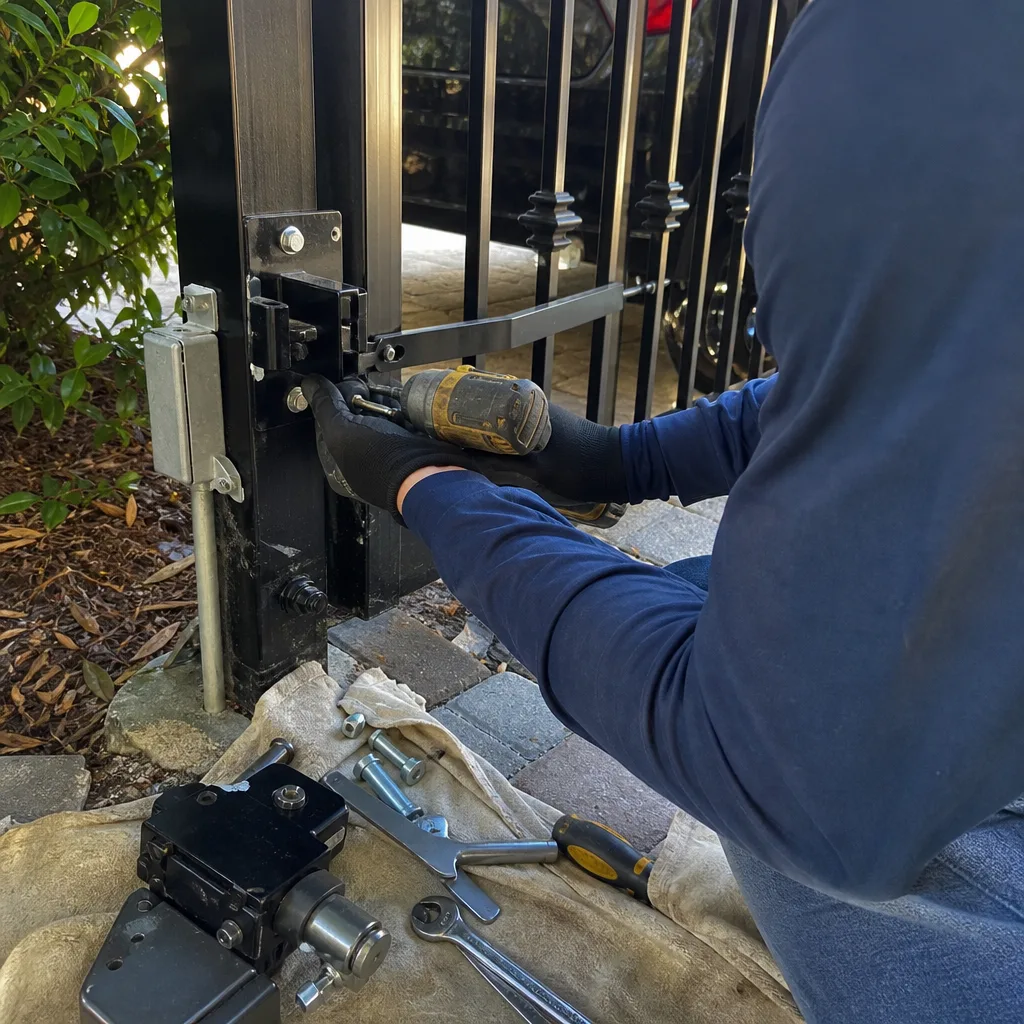
These tasks meet all three criteria of the Reversibility Rule: visible starting state, no stored energy, and no safety-system dependency.
Remote Battery and Basic Maintenance
Gate remote batteries typically last 12 to 24 months in Los Gatos’s mild climate, though hillside homes with longer transmitter distances may see shorter life. Replacement requires only a small Phillips head or the coin-slot opener on the remote case. Use a CR2032, A23, or whatever the manufacturer specifies. The reversible test: if the new battery doesn’t restore function, the old one wasn’t the problem, and you haven’t changed anything else.
Photo-Eye Cleaning
The photo-eye consists of an infrared emitter and receiver, usually mounted 4 to 6 inches above ground on opposite gate posts. Spider webs, dust, and moisture film on the lens are the leading cause of “gate won’t close” calls in Los Gatos’s oak-and-redwood canopy. Clean both lenses with a dry microfiber cloth. Check that the LED indicator on the receiver shows solid alignment (usually green or amber, depending on brand). If it flickers, something is blocking the beam path: a shifted plant, accumulated leaves, or a spider that rebuilt its web in the last hour.
Debris Removal from Track and Rollers
Sliding gates on hillside properties collect gravel, acorns, and leaf matter in the track. A stiff brush and a shop vacuum handle this. For swing gates, check that nothing obstructs the arc: sprinkler heads that have shifted, ground cover that has grown, or a child’s toy left in the path. These are environmental issues, not mechanical failures, and no documentation is needed because there’s no adjustment to reverse.
Visual Inspection of Hardware
Look for cracked welds at hinge points, loose bolts on gate arms, or corrosion on chain-drive assemblies. Don’t tighten or adjust yet. Note what you found. This inspection is valuable information for any technician you later call, and it costs nothing. In our experience at Gate Repair in Los Gatos, a homeowner who can say “the upper hinge weld has a crack starting” saves 15 to 20 minutes of diagnostic time.
Lubrication of Accessible Hinges
Use a lithium-based grease on steel hinge pins, not WD-40. WD-40 is a solvent and light lubricant; it evaporates and leaves metal unprotected. Apply sparingly, wipe excess, and cycle the gate manually to distribute. This is reversible because you can wipe it off if you used the wrong product.
DIY With Documented Baseline First
These tasks sit in a middle zone. A competent homeowner can perform them, but only after recording the exact starting position of every adjustable component. Without that record, a mistake becomes expensive detective work.
Photo-Eye Realignment
When cleaning doesn’t restore the solid LED indicator, the bracket may have shifted. Before touching anything:
- Photograph the current bracket position from directly above, directly in front, and at eye level with the beam path.
- Measure the height of each bracket from ground level and the distance between bracket faces.
- Note the LED color and behavior before adjustment.
- Loosen the bracket just enough to move it, then shift in 1/8-inch increments, testing the LED after each move.
- If the gate still won’t close after three shifts in each direction, stop. You have documented the original position and can restore it exactly. Call for help.
The documentation matters because photo-eye alignment interacts with gate travel programming. On some Ghost Controls and BFT systems, the control board monitors photo-eye continuity during the entire close cycle. A marginal alignment may pass the LED test but fail under vibration or temperature change. The technician who arrives needs to know where you started.
Limit Switch Adjustment (Swing Gates)
The limit switch tells the operator when the gate has reached fully open or fully closed. Symptoms of misalignment include the gate stopping short, overrunning the stop post, or reversing unexpectedly. Before adjusting:
- Photograph the cam or magnet position on the drive shaft.
- Mark the current position with a Sharpie line on the shaft and the cam.
- Count the exposed threads on any threaded adjustment rod.
- Record the control board’s current open and close time settings, usually displayed in seconds.
Adjust in the smallest increment the mechanism allows, typically 1/16 turn or one tooth on a cam gear. Test with the gate unloaded first (disconnect the arm if the manual specifies how), then loaded. If the gate overshoots by any amount, stop. Overshoot on a downhill swing gate in Los Gatos’s hillside neighborhoods can accelerate the gate past the operator’s braking capacity.
We document every limit-switch adjustment with a photograph of the final cam position and a written record of the time settings. Under Clause 4 (Evidence on every job), every visit includes a documented photo record at no additional charge. Homeowners attempting this themselves should hold themselves to the same standard.
Chain Tension (Sliding Gates)
Loose chain causes jerky movement and premature sprocket wear. Too tight overloads the motor and strains bearings. The correct tension allows approximately 1/2 inch of vertical deflection at the midpoint. Before adjusting the tensioner:
- Photograph the current tensioner position and count exposed threads.
- Measure and record the current deflection with a ruler.
- Adjust in quarter-turn increments, measuring after each.
Chain tension interacts with limit-switch positioning on sliding gates. A tighter chain reaches the physical stop sooner, which may require limit adjustment to prevent motor stall. This is where DIY without documentation cascades: you adjusted the chain, now the limit is wrong, now the safety edge timing is off. Document each variable independently.
Professional-Only: Tasks That Require Training and Equipment
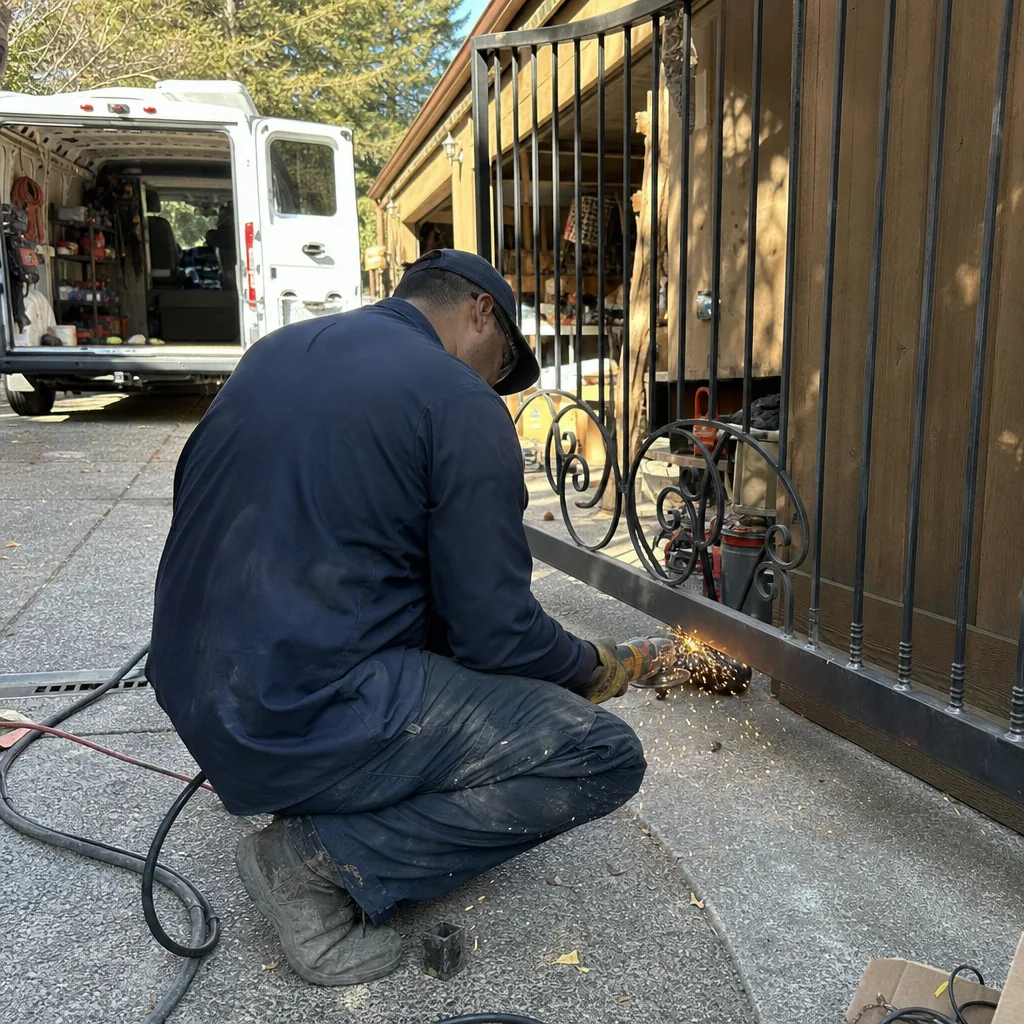
These tasks fail the Reversibility Rule on multiple grounds: stored energy, legal liability, interdependent safety systems, or the need for calibrated test equipment.
Control Board Programming and Replacement
Modern gate operators use microprocessor-controlled boards with dozens of parameters: motor torque curves, deceleration profiles, safety-device response times, and force-limiting algorithms. A Gate Motor & Opener in Los Gatos with a Linear or Viking board may have 30 to 50 programmable values. The factory default is rarely correct for the installed gate. Restoring operation requires:
- The manufacturer’s parameter sheet for the specific model and firmware version
- A meter to verify input voltages and safety-device continuity
- Knowledge of which features are actually wired (a board may support five safety inputs while the installation uses two)
- A force-test gauge to verify compliance with UL 325 entrapment protection standards
Incorrect programming can defeat safety devices without any visible indication. The gate may appear to operate normally while failing to reverse when it strikes an object. This is a liability exposure that no homeowner should accept.
Safety-Device Testing and Certification
California Business and Professions Code and local Los Gatos building enforcement require that automatic gates meet UL 325 standards for entrapment protection. Testing requires a calibrated force gauge, a stop-watch, and knowledge of the acceptable force thresholds (typically 40 lbf for in-ground loops, 20 lbf for contact edges, with specific time limits). We cover the specific tests in the next section.
Spring and Counterbalance Work
Some ornamental swing gates use torsion or extension springs to reduce motor load. These springs are under significant tension. A winding bar slipped from a torsion spring cone can cause serious injury. The stored energy is not visible, and the release is instantaneous. This is not comparable to garage door springs, which at least have established DIY procedures with specific safety tools. Gate spring systems vary widely by manufacturer and age, and documentation is rarely available.
Welding and Structural Repair
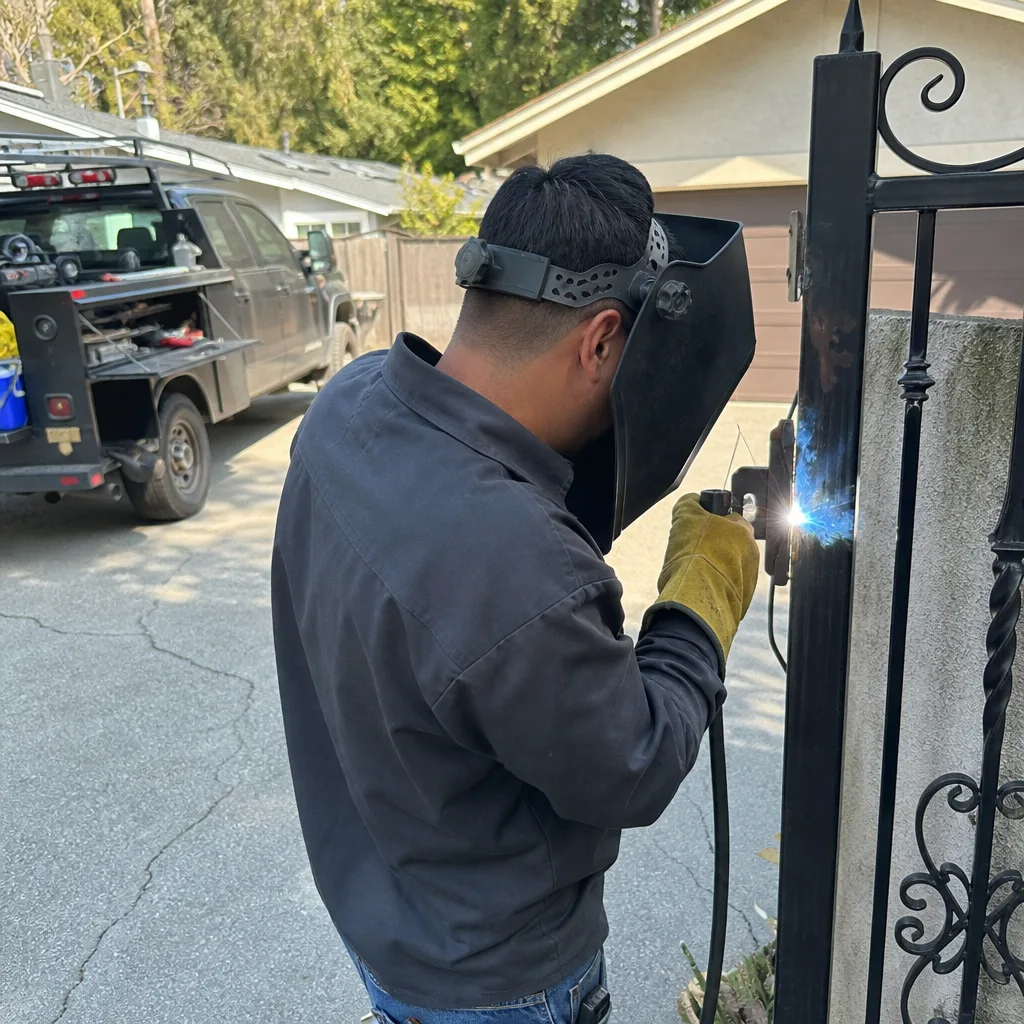
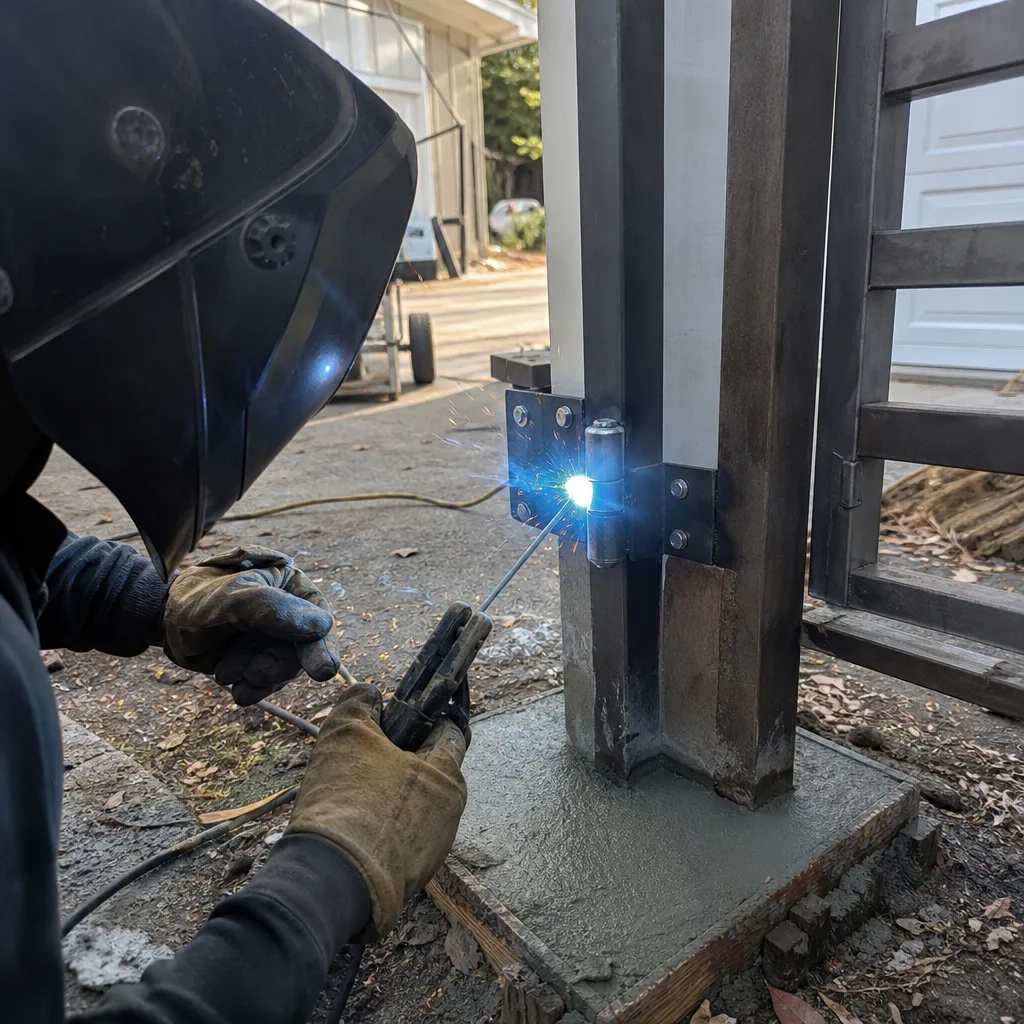
Cracked hinge welds, bent gate frames, or damaged support posts require structural repair. Welding affects metallurgy in ways that aren’t visible: heat-affected zone weakening, residual stress, and galvanic corrosion acceleration if dissimilar metals are involved. A Gate Installation in Los Gatos must withstand Santa Clara County wind loads and, in many cases, seismic movement. Amateur welding on a 600-pound gate creates liability that affects insurance coverage if the gate later fails and causes injury.
Electrical Supply and Grounding
Gate operators require dedicated 120V or 240V circuits with proper grounding and GFCI protection where required by code. Los Gatos’s older hillside homes often have ungrounded or undersized circuits from original construction. Extending or modifying electrical supply requires a licensed electrician in California, not just a gate technician. The intersection of gate control voltage (typically 24V DC) and line voltage creates shock and fire hazards when improperly handled.
Underground Loop Installation and Repair
Vehicle detection loops are installed in saw-cut grooves in the driveway, sealed with epoxy, and connected to a loop detector in the operator cabinet. Diagnosing loop failure requires an inductance meter to measure loop integrity. Installing a replacement loop requires knowledge of loop geometry (typically 6 to 8 feet per side for a standard vehicle loop), proper number of turns, and correct placement relative to the gate path. A loop installed too close to metal reinforcement or with incorrect turns will false-trigger or fail to detect.
UL 325 Safety Tests: What California Homeowners Must Know
UL 325 is the standard for door, drapery, gate, louver, and window operators and systems. In California, homeowners with automatic gates are legally responsible for maintaining entrapment protection. This isn’t a suggestion or a best practice. It’s a statutory obligation with real liability exposure.
The tests that must be performed require equipment most homeowners don’t own:
Force-Limited Reversal Test
Using a calibrated force gauge, measure the force the gate exerts when it contacts an obstruction during closing. For residential vehicular gates without contact sensors, the force must not exceed 40 lbf, and the gate must reverse within 2 seconds of contact. For pedestrian gates or gates with contact edges, thresholds are lower. The test must be performed at multiple points in the travel arc, because gate geometry affects mechanical advantage and thus contact force.
Non-Contact Sensor Test (Photo-Eye Response)
Interrupt the photo-eye beam during closing at various points in the travel. The gate must stop and reverse within specified time limits. This tests not just the beam itself but the control board’s response programming. A photo-eye that passes the LED alignment test may still fail if the board’s response timer is set incorrectly.
Contact Edge Test
Safety edges are pressure-sensitive strips mounted on the leading edge of the gate. Test with the manufacturer’s specified method, usually a firm hand press at multiple points along the edge. The gate must stop and reverse. Edge sensitivity degrades with age and UV exposure; Los Gatos’s 260+ days of annual sun accelerate this degradation.
Audio/Visual Warning Test
UL 325 requires audible and visual warning before gate movement. Test that the strobe or warning light operates and that the horn or bell sounds for the required duration (typically 5 seconds before movement).
Why These Tests Require a Professional
The force gauge alone costs $400 to $800 for a calibrated unit. The knowledge to interpret results against the specific operator model’s programming requires training. And the documentation of test results, with date, technician, and measured values, is evidence of due diligence if liability is ever questioned.
At Vance Gate Repair Los Gatos, we perform these tests on every service call that involves safety-device adjustment or control board work. The results are photographed and included in the job record under Clause 4. Homeowners receive a copy. This isn’t extra service; it’s standard procedure, because untested safety devices are a known hazard that we’ve seen cause injury.
Real Cost Comparison: DIY vs Professional in Los Gatos (2026)
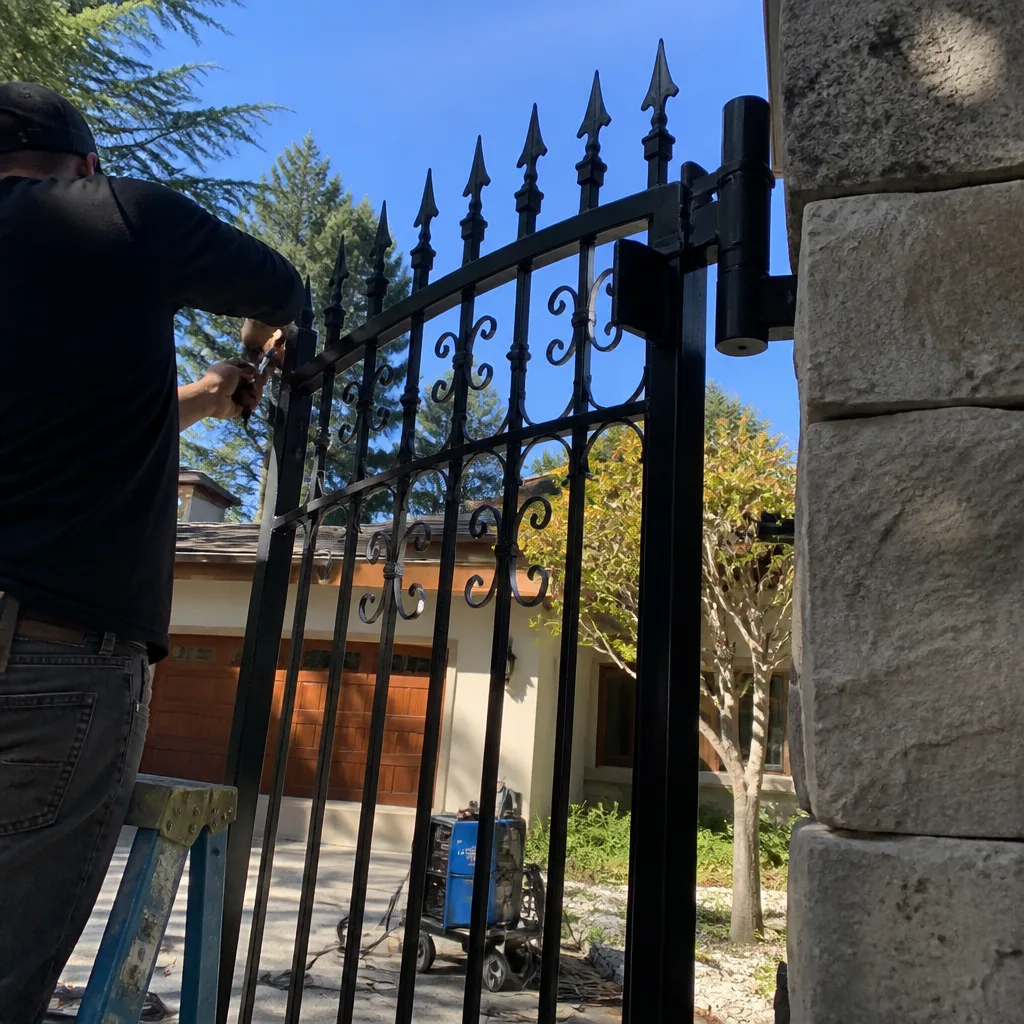
Cost decisions should include parts, time, risk of error, and the cost of correcting that error. Here’s what common scenarios actually run in the Los Gatos market, based on our service records and local parts pricing.
Scenario 1: Remote Not Working
DIY: Battery ($3-$5), 10 minutes. Risk: minimal. If the battery wasn’t the problem, you’ve spent $5 and know to call.
Professional: Diagnostic visit $120-$180, plus battery if that’s all it was. Most reputable companies, including ours, will apply the diagnostic fee to repair if you proceed.
Verdict: Try the battery first. Document the old battery’s voltage with a multimeter if you have one; a reading below 2.8V on a 3V battery confirms it was failing.
Scenario 2: Gate Stops Short of Full Close
DIY with documentation: Time to inspect, clean, and attempt photo-eye realignment: 1 to 2 hours. No parts cost if successful.
DIY without documentation, then professional correction: Your time (2 hours) plus professional diagnostic and restoration of original settings: $180-$280. If you damaged the photo-eye bracket by overtightening: add $45-$85 for the bracket.
Professional from the start: Diagnostic and adjustment $180-$240. Includes documentation of final settings and UL 325 safety verification.
Verdict: Documented DIY attempt is reasonable. Undocumented attempt is false economy.
Scenario 3: Control Board Failure After Power Surge
DIY: Replacement board ($200-$450 depending on brand and age), your time (3-6 hours for removal, installation, and attempted programming), risk of incorrect programming that defeats safety devices or damages the motor.
Professional: Board plus installation and programming $480-$890. Includes parameter verification, force testing, and documented record.
Hidden cost of DIY error: Incorrect torque setting burns out motor ($380-$720). Incorrect safety programming creates liability exposure. We’ve replaced three motors in the last two years where the root cause was a homeowner-installed board with default parameters.
Verdict: Professional. The risk asymmetry is too large.
Scenario 4: Broken Weld at Hinge
DIY: Harbor Freight welder ($200+), consumables, your time, no structural engineering knowledge, no load testing, potential insurance void if gate later fails.
Professional: Mobile welding and structural assessment $280-$520. Includes material specification verification (many Los Gatos gates from the 1990s use steel grades that require specific filler rod), stress-relief consideration, and load-test documentation.
Verdict: Professional. The liability exposure exceeds any savings.
Scenario 5: Annual Maintenance and Safety Certification
DIY: Your time (4-6 hours), no equipment cost if you skip force testing, no documentation for liability protection.
Professional: $220-$340 for comprehensive service including all UL 325 tests, lubrication, hardware inspection, and documented record.
Verdict: Professional for the safety tests; DIY for cleaning and visual inspection between annual visits.
Summary Table
| Task | DIY Cost | Pro Cost | Risk of DIY Error |
|---|---|---|---|
| Remote battery | $3-$5 | $120-$180* | Negligible |
| Photo-eye cleaning | $0 | $120-$180* | Low |
| Photo-eye realignment (documented) | $0 + 1-2 hrs | $180-$240 | Moderate |
| Limit switch adjustment (documented) | $0 + 1-2 hrs | $180-$280 | Moderate to high |
| Control board replacement | $200-$450 + 3-6 hrs | $480-$890 | High (safety, motor damage) |
| Welding/structural repair | $200+ equipment | $280-$520 | Very high (liability) |
| Annual safety certification | $0 + 4-6 hrs | $220-$340 | High (legal exposure) |
*Diagnostic fee, typically applied to repair if performed
Common Mistakes to Avoid
- Adjusting without a baseline. Every adjustment should start with a photograph and measurement. We’ve restored settings from homeowner “improvements” that took 45 minutes of detective work because no one recorded the original position. In Los Gatos’s competitive service market, that detective work is billable time.
- Using the wrong lubricant. WD-40 on gate hinges attracts dust and dries to a gummy residue. Use lithium grease on metal, silicone spray on plastic guides. A homeowner in the Glenridge neighborhood used motor oil on a nylon roller track; the swelling destroyed the rollers in six weeks.
- Ignoring the manual release. Every operator has a manual release for power failure or service. Homeowners who don’t know its location or operation are trapped when the power goes out or a repair goes wrong. Locate it, test it, and make sure household members know how to use it.
- Assuming all brands work the same. A procedure that works on a Mighty Mule residential opener can damage a BFT industrial board. The parameter names, access procedures, and safety architectures differ significantly. We’ve seen control boards factory-reset to European standards because a homeowner followed a generic online guide.
- Skipping the safety test after “fixing” something. If you adjusted anything that affects travel or force, verify that the safety devices still function. The photo-eye that worked before your adjustment may now be misaligned. The edge sensor that passed before may now have a pinched wire. Test every safety device after any mechanical or electrical change.
- Working alone on heavy gates. A 600-pound steel slide gate can shift on its track if a roller fails during inspection. A swing gate on a slope can accelerate unexpectedly if the operator is disconnected. Have someone present who can call for help or stabilize the gate.
- Calling the cheapest quote without a written scope. Los Gatos has gate companies that quote low and invoice high. A verbal estimate for “fix the gate” can become a $2,400 bill with no recourse. Under the Haven Standard, we provide a written scope and written price before any work starts. If another company won’t do the same, that’s information.
When to Call a Professional
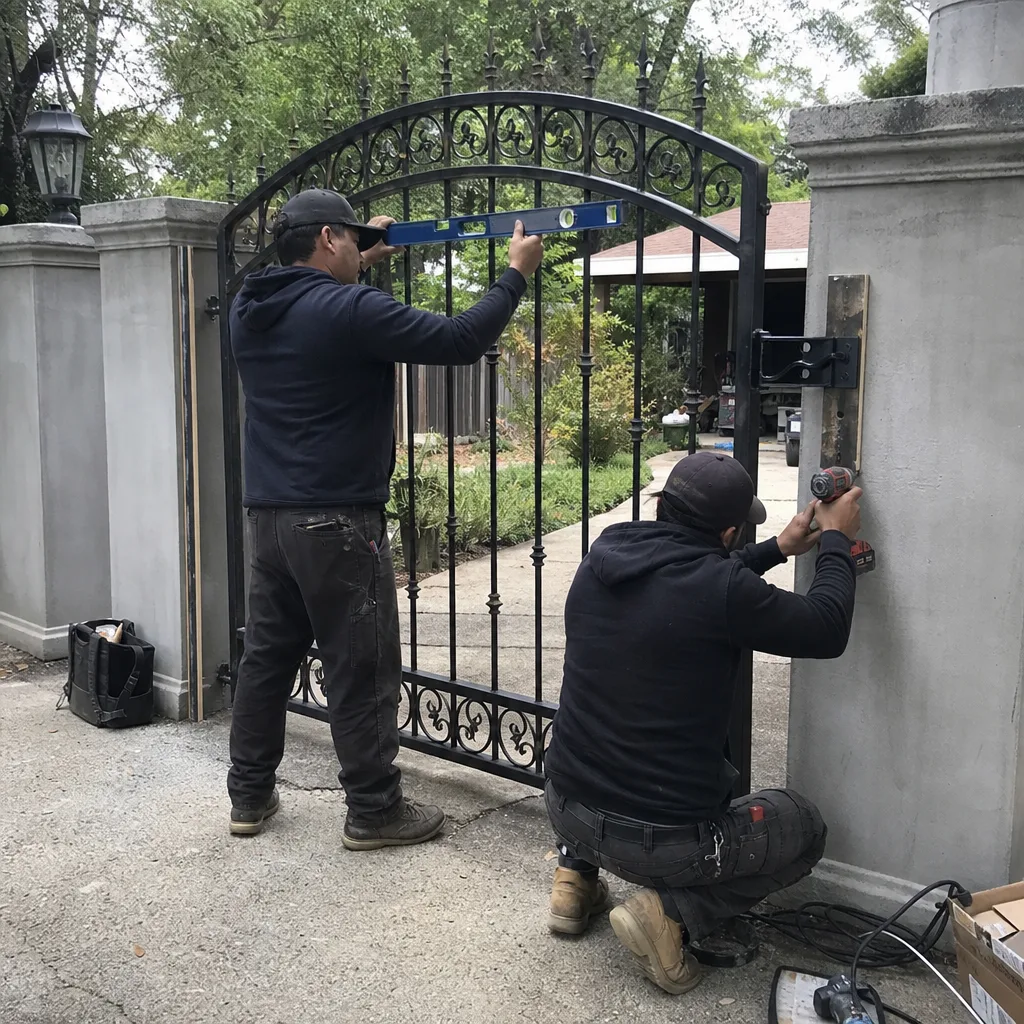
Call when the task is irreversible, when safety devices are involved, when electrical supply requires modification, or when you’ve documented your baseline and still can’t achieve correct operation. In Los Gatos, where gate systems range from 1980s vintage to current smart-home integrated, the probability of hidden interdependencies is high.
Specific scenarios that warrant immediate professional attention: any gate that has struck a vehicle or person (requires force re-verification); any control board replacement; any welding or structural repair; any safety-device malfunction; any gate that operates erratically after a power surge or lightning strike; and any situation where the gate is a security barrier for a home with children or pets.
Vance Gate Repair Los Gatos offers free estimates in Los Gatos. Call (831) 246-7187. We’ll review what you’ve found, what you’ve documented, and what the repair requires. If you’ve already attempted adjustment, bring your photographs and measurements. They’ll save diagnostic time and reduce your cost. Under Clause 1 of the Haven Standard, you’ll receive a written scope and written price before any work starts. Under Clause 4, every visit includes a documented photo record. And under the 365-Day Done Right Promise, any repair that isn’t right is made right at no additional charge within one full year.
Frequently Asked Questions
Most residential gate repairs in Los Gatos range from $180 for a documented adjustment to $890 for control board replacement with full safety certification. Diagnostic visits run $120-$180, applied to repair if you proceed. Welding and structural work typically falls between $280 and $520. Call (831) 246-7187 for a written estimate specific to your gate, estimates are free.
Rarely, and often the opposite. We source parts through manufacturer-authorized distribution with warranty support. Homeowner-sourced parts often lack warranty, may be counterfeit or obsolete stock, and create liability ambiguity if they fail. In 22,000+ jobs since 2014, we’ve seen control boards purchased online that were programmed for European voltage, photo-eyes that were visually identical but optically incompatible, and “new” motors that were refurbished units with wiped date codes. The savings evaporate when the part fails and the supplier is unreachable.
Keep the operator manual with model and serial number, any previous service records with part numbers, and photographs of control board settings and limit-switch positions. If you have a Gate Installation in Los Gatos performed by Vance Gate Repair, we provide a complete job record including wiring diagrams, photographed settings, and parts installed. Store this with your home records; it transfers to the next owner and eliminates guesswork for any future technician.
UL 325 recommends monthly homeowner visual inspection and annual professional force testing and certification. In Los Gatos’s climate, photo-eye lenses should be cleaned quarterly due to dust and pollen accumulation. Safety edges should be tested monthly by pressing firmly at multiple points. If any test fails, discontinue automatic operation and call for service.
Not necessarily. Age alone isn’t a failure mode. We service operators from the 1990s that function correctly because they’ve been maintained and their safety devices upgraded to current standards. The decision point is parts availability and safety compliance. If the manufacturer no longer supports the model and no aftermarket parts are available, replacement becomes prudent planning rather than emergency spending. We can assess your specific operator and give you a realistic lifespan estimate with written documentation.
A gate technician understands the intersection of mechanical travel, control logic, and safety-device integration. An electrician understands code-compliant power distribution. For issues inside the operator cabinet, call a gate technician. For supply circuit problems, underground wire faults, or panel upgrades, call an electrician. Some situations require both. At Vance Gate Repair Los Gatos, we coordinate with licensed electricians when the scope exceeds gate-specific work, and we document the interface points so nothing is lost in handoff.
The Bottom Line
The DIY-versus-professional question for gate repair isn’t about whether you’re handy. It’s about whether a mistake is reversible and whether you have the equipment to verify safety after you’re done. Replace batteries, clean photo-eyes, and remove debris yourself. Document everything before adjusting anything. Leave control boards, welding, and safety certification to trained technicians with meters, parameter sheets, and liability insurance. In Los Gatos, where gate systems protect homes on steep lots and busy streets, the cost of getting it wrong exceeds the cost of getting it documented and done right. The Haven Standard exists because we’ve seen what happens when it isn’t followed, and because every homeowner deserves to know the price before the work starts and to have proof of what was done after the technician leaves.
Written by Adrian Vance, Owner at Vance Gate Repair Los Gatos, serving Los Gatos since 2014.